
1. Fine-Tuning of the Universe (Empirical / Mathematical)
The fundamental physical constants — gravitational force, strong nuclear force, cosmological constant, electromagnetic coupling, and others — fall within extraordinarily narrow life-permitting ranges. Alter any of them by small amounts and you get a universe with no stars, no chemistry, and no life. The probability of this occurring by unguided chance on a single-universe hypothesis is astronomically low. On a theistic hypothesis, life-permitting conditions are far less surprising, giving the argument considerable Bayesian force. Critics respond with multiverse models and anthropic selection effects, but the argument remains widely regarded as the strongest modern case for theism.
Type: Empirical + Mathematical
Strongest counterargument — The measure problem and anthropic selection: The probabilities cited in fine-tuning arguments are ill-defined because we do not know the possible range or probability distribution over physical constants. Without a well-defined measure, claims like “the gravitational constant is fine-tuned to one part in 10^60” are not meaningful probabilities — they are ratios presented as though they were drawn from a known distribution. Furthermore, anthropic selection guarantees that any observers will find themselves in a life-permitting region regardless of whether the constants were set by design or by chance across a multiverse. We could not observe a universe in which we do not exist. The appearance of fine-tuning may therefore be an observational artifact rather than evidence of intention.
TRIVERITAS COMPARATIVE EVALUATION
THEORY A: The Fine-Tuning Argument for God’s Existence
Step 1. CLAIM FORMALIZATION AND STRUCTURAL ANALYSIS
Restated Claim: The physical constants of the universe fall within extraordinarily narrow life-permitting ranges; the probability of this occurring by unguided chance on a single-universe hypothesis is astronomically low; on a theistic hypothesis the life-permitting conditions are expected rather than surprising; therefore the fine-tuning of the universe constitutes strong Bayesian evidence for the existence of a designing intelligence (God).
Extracted Categorical Claim: The fine-tuning of the universe’s physical constants is evidence for the existence of God.
Premises: P1. The fundamental physical constants (gravitational constant G, strong nuclear force coupling, cosmological constant Λ, electromagnetic coupling constant α, and others) are observed to fall within extremely narrow ranges that permit the existence of stars, chemistry, and life. P2. Small alterations to any of these constants would yield a universe incompatible with life (no stars, no chemistry, no complex structure). P3. On a single-universe hypothesis with no designing intelligence, the probability of the constants landing in the life-permitting range is astronomically low. P4. On a theistic hypothesis (a designing intelligence sets the constants), life-permitting conditions are not surprising — they are expected or at least far less improbable. P5. (Bayesian inference) When one hypothesis renders an observation far more probable than another, the observation constitutes evidence favoring the first hypothesis.
Conclusion: The fine-tuning of physical constants constitutes considerable Bayesian evidence for the existence of God.
Domain of Application: Natural theology / philosophy of religion / Bayesian epistemology, with inputs from theoretical physics and cosmology.
Key Assumptions: A1. The constants could in principle have been different (they are not logically or physically necessary at their observed values). A2. There exists a meaningful probability distribution over possible constant values (or at least the claim that the life-permitting range is “narrow” is meaningful). A3. The Bayesian likelihood ratio P(fine-tuning | theism) / P(fine-tuning | chance) is large. A4. “God” or “designing intelligence” is the kind of entity whose intentions would plausibly include producing a life-permitting universe.
Structural Equivocation (Amphiboly Check): A potential equivocation exists in the term “probability” as applied to physical constants. Reading A: the life-permitting range is a narrow subset of a mathematically well-defined parameter space, and the probability is a legitimate measure over that space. Reading B: “probability” is used loosely to express the intuition that fine-tuning is surprising, without a rigorously defined measure. The argument’s Bayesian force depends on Reading A. The counterargument (Theory B) targets precisely this equivocation. For this evaluation, I assess Theory A under its strongest defensible reading — Reading A — while noting the equivocation as a vulnerability.
Recursive Structure: This is primarily a philosophical/theological argument with inputs from physics. The recursive model (H, P, B) applies partially:
H: Theistic design hypothesis — an intelligent agent set the constants to permit life.
P: Bayesian likelihood reasoning — the argument generates the qualitative prediction that if theism is true, we should observe life-permitting constants. It does not generate quantitative predictions of specific constant values from theistic premises.
B: The observed values of physical constants (G, α, Λ, strong coupling, etc.) and the physics showing life-sensitivity to their values.
The base cases (the measured constants and the physics of life-sensitivity) are structurally warranted by independent physics. However, the prediction function is qualitative, not quantitative: theism predicts “life-permitting constants” but not which specific values.
Applicability Notes: All three dimensions are applicable. M applies at Layer 2 (indirect): the argument makes implicit quantitative commitments via its probability claims and Bayesian structure.
Step 2. LOGICAL VALIDITY (L)
Explanatory Unity: The fine-tuning argument has genuine explanatory unity. It operates from a single principle: an intelligent designer explains the appearance of purpose (life-permitting conditions) better than unguided chance. The argument does not require a separate ad hoc explanation for each constant — the design hypothesis covers all of them under a single umbrella. This is structurally superior to a framework that requires independent accommodations for each fine-tuned parameter.
Deductive Validity: The Bayesian core of the argument is deductively valid. If P(E|H₁) >> P(E|H₂), then observing E raises the posterior probability of H₁ relative to H₂. This is a straightforward application of Bayes’ theorem. The conclusion (fine-tuning is evidence for theism) follows from the premises as stated. Applying G3: the argument asserts “whether” fine-tuning constitutes evidence, not “how” God implemented the design. No mechanistic “how” demand is appropriate here.
Hidden Structure: The argument carries several load-bearing assumptions:
A1 (constants could have been different) is unproven but widely accepted in physics as a working assumption. It is not self-evidently true — some physicists argue the constants may be fixed by a deeper theory.
A2 (meaningful probability over constants) is the most vulnerable assumption. Without a well-defined measure, the “astronomically low probability” claim (P3) floats without rigorous grounding. This is a genuine weakness, though not a logical contradiction.
A4 (God would plausibly want life) imports a premise about divine intention that is defensible within theistic traditions but not derivable from the argument’s own structure.
Ad Hoc Resistance: The argument is reasonably resistant to ad hoc modification. It makes a definite commitment: life-permitting constants are expected under theism and surprising under chance. If the constants were found not to be fine-tuned (e.g., if a deeper physical theory showed only one possible set of constants), the argument would lose its force. This is a mark of genuine logical structure.
Structural Equivocation Impact: The equivocation on “probability” (identified in Step 1) is a real weakness on L. The argument’s logical force depends on the probability claims being meaningful. If they are not (if no well-defined measure exists), then P3 is not a well-formed premise, and the Bayesian inference in P5 operates on an ill-defined input. However, under Reading A (the charitable reading), the logical structure holds. The equivocation weakens the argument but does not make it incoherent.
Principled Stopping: The explanatory chain terminates at “a designing intelligence set the constants.” This termination raises the classic “who designed the designer?” regress question. The argument’s defenders (e.g., Swinburne, Craig) respond that God is posited as a necessary being whose existence requires no further explanation — a brute fact at the terminus. This is a principled stopping point within theistic metaphysics, though whether it is structurally warranted or merely asserted depends on one’s metaphysical commitments.
L ~ 62.
Nearest L Scale Anchor: Between L~60 (Quantum Mechanics, Copenhagen interpretation — coherent principle with significant unresolved internal tensions) and L~65 (Kinetic theory of gases — strong mechanistic principle with known simplifying assumptions). The fine-tuning argument has genuine explanatory unity and valid Bayesian structure, but carries unresolved tensions around the measure problem and the regress question.
Strengths: Genuine explanatory unity; valid Bayesian inference structure; makes commitments that could in principle be defeated; unifies the fine-tuning of multiple constants under a single hypothesis.
Weaknesses: The “probability” equivocation means the argument’s key premise (P3) may not be well-formed; the explanatory chain terminates at a posited necessary being, which some will regard as ad hoc; the prediction is qualitative (”life-permitting”) rather than specific (”these exact values”).
Step 3. MATHEMATICAL COHERENCE (M)
Preliminary: The statistical observations about fine-tuning (the narrowness of life-permitting ranges) are empirical data analysis and belong to E. M asks whether the argument possesses mathematical architecture that generates quantitative predictions from its own structure.
Applicability — Layer 2 (Indirect): The argument makes implicit quantitative commitments. The Bayesian framework requires a likelihood ratio, which requires defined probabilities. P(fine-tuning | theism) and P(fine-tuning | chance) must be at least roughly quantifiable for the argument to have Bayesian force. The argument also cites specific numerical claims (e.g., “gravitational constant fine-tuned to one part in 10⁶⁰”).
Internal Consistency: The Bayesian mathematics is internally consistent — Bayes’ theorem itself is not in dispute. The question is whether the inputs to the theorem are well-defined. The fine-tuning argument does not generate the specific values of constants from its own theoretical principles. It observes the values, notes they are life-permitting, and argues this is evidence for design. The mathematical apparatus is Bayesian inference, which is borrowed rather than generated from the theory’s own commitments.
M-Derived vs. E-Fitted: The numerical fine-tuning claims (the sensitivity of life to constant variations) are derived from independent physics (nuclear physics, stellar astrophysics, cosmology). These are legitimate inputs. However, the theistic hypothesis itself generates no M-derived prediction of what the constants should be. It predicts “life-permitting” qualitatively but not “G = 6.674 × 10⁻¹¹” specifically. The probability estimates over the space of possible constants (P3) lack a rigorously defined measure — this is the measure problem. Without a well-defined probability distribution over the space of possible physical constants, the quantitative claims (e.g., “one part in 10⁶⁰”) are ratios presented as probabilities without a demonstrated underlying distribution. This is a significant M weakness: the numbers look precise but rest on an undefined measure.
Quantities Finite and Computable: The Bayesian framework is finite and computable in principle. The fine-tuning sensitivity calculations (from physics) are well-defined. The prior probability of theism and the measure over constant-space are not well-defined.
M ~ 35.
Applicability Layer: Layer 2: Indirect.
Implicit Structure Identified: Bayesian likelihood ratio requires defined probabilities over the space of possible constant values. The sensitivity calculations (from physics) are well-defined. The probability measure over the constant-space is not.
Nearest M Scale Anchor: Between M~30 (Ptolemaic epicycles — mathematically tractable but with free parameters fitted to observations) and M~40 (Marxist theory of class conflict — quantitative implications without rigorous derivation). The Bayesian structure is valid but its inputs rest on an undefined measure. The argument borrows well-defined mathematics (Bayes’ theorem, physics calculations) but generates no M-derived quantitative predictions from its own theistic premises.
Strengths: Bayesian inference is a legitimate and internally consistent mathematical framework; the physics of fine-tuning sensitivity is well-established; the argument is at least formulable in probabilistic terms.
Weaknesses: The probability measure over the space of possible constants is undefined; the theistic hypothesis generates no specific quantitative prediction of constant values; the “astronomically low probability” claim depends on a measure that has not been rigorously established; the prior probability of theism is not formally derivable.
Step 4. EMPIRICAL ANCHORING (E)
Novel Prediction: The fine-tuning argument does not generate novel predictions in the strong scientific sense. It is constructed from already-known empirical facts (the observed values of constants and their life-sensitivity). It is an explanatory argument, not a predictive one. That said, it makes a structural prediction: as physicists discover additional constants or parameters, those too will prove to be fine-tuned for life. This is a genuine (if qualitative) prediction, and it has been partially confirmed: as physicists have examined more parameters (the cosmological constant, the proton-neutron mass difference, the strength of the strong force), each has turned out to be life-sensitive. This is not post hoc accommodation — the prediction was stated in advance by fine-tuning proponents and subsequently confirmed as new parameters were analyzed.
Independent Testing: The physics underlying fine-tuning has been independently tested. The values of fundamental constants are among the most precisely measured quantities in science. The life-sensitivity analyses (e.g., what happens if you change α by 4%) are derived from well-established nuclear physics and stellar astrophysics. These are not contested.
Evidence Independence: The fine-tuning data is independent of the theistic hypothesis — the constants were measured by physicists without reference to theology. However, the argument was constructed to explain pre-existing data, which limits its E score. The partial confirmation comes from the “prediction” that additional parameters would also prove fine-tuned.
Refutation Status: No empirical observation has directly refuted the claim that the constants are fine-tuned for life. The physical facts (narrow life-permitting ranges) are not in dispute. What is in dispute is the interpretation of those facts.
Self-Sealing Check: The fine-tuning argument is not structurally self-sealing. It can be constrained by external findings. If a deeper theory of physics demonstrated that the constants must take their observed values (that they are not free parameters), the argument would lose its force. If a concrete multiverse model generated testable predictions that were confirmed, the argument would be weakened. These are genuine external constraints.
E ~ 55.
Nearest E Scale Anchor: Between E~50 (Phillips Curve — significant confirmed predictions alongside significant failures) and E~55 (Hubble’s expanding universe — most major predictions confirmed with notable exceptions). The empirical base (the fine-tuning data itself) is rock-solid. The weakness is that the argument is primarily explanatory rather than predictive, and the theistic interpretation of the data has not generated novel testable predictions distinguishable from other interpretations. The partial confirmation of “additional parameters will also prove fine-tuned” provides moderate empirical support.
Strengths: The underlying physics is among the best-established in science; the life-sensitivity of constants is independently confirmed by multiple lines of physical analysis; the qualitative prediction of additional fine-tuning has been partially confirmed; the argument is not self-sealing.
Weaknesses: The argument is constructed from pre-existing data rather than generating novel predictions; the theistic interpretation has not produced predictions distinguishable from competing interpretations; the empirical contact is with the physics, not with the theological hypothesis directly.
Step 5. FAILURE MODE ANALYSIS
Dimensional Scores: L~62, M~35, E~55.
Step 5a. Gap between highest (L~62) and lowest (M~35) = 27 points. M is below 50 while L is above 60. This approaches the pairwise pattern threshold (two above 60 and one below 50). The pattern is L ∩ E without M.
Step 5b. The imbalance on M reflects an identifiable structural gap: the theistic hypothesis does not possess mathematical architecture that generates quantitative predictions from its own principles. The Bayesian framework is borrowed, and the crucial inputs (the measure over constant-space) are undefined. Is this structural failure or asymmetric development?
This is closer to structural limitation than developmental gap. The argument is philosophical/theological in character, and the absence of a mathematical prediction function is not something that “needs more work” in the way Wegener’s drift needed plate tectonics. Rather, the argument’s nature as a design inference limits its capacity for M-derived prediction. A designer hypothesis that predicted specific constant values from theistic principles would be a fundamentally different kind of claim.
Deflection Evidence: Defenders of the fine-tuning argument do exhibit a deflection pattern: when challenged on the measure problem (an M weakness), they tend to redirect to the strength of the empirical data (the rock-solid physics of fine-tuning) and the logical validity of the Bayesian inference structure. This is the L ∩ E deflection of M weakness pattern. However, this deflection is less severe than in cases like Ptolemy or phlogiston because the M weakness is partially inherent to the argument’s philosophical domain.
Output: Failure Pattern: L ∩ E without M Deflection Evidence: Present (moderate — redirect from measure problem to empirical strength) Explanation: The theistic hypothesis borrows mathematical machinery (Bayesian inference, physics calculations) but generates no M-derived quantitative predictions from its own principles. The measure problem means the key probabilistic inputs are undefined. Predicted Vulnerability: A well-defined measure theory or a deeper physical theory fixing the constants would transform the evaluation. Score Revision: M revised slightly downward to M~33 due to deflection evidence.
Step 6. TRIVERITAS SYNTHESIS
Profile: (L~62, M~33, E~55)
Composite Score: (62 + 33 + 55) / 3 = 50.0
Minimum Score: 33 (M)
Interpretation: The minimum score of 33 on M is above 25 (so the claim is not outright failed on that dimension), but below 50 (the constraint threshold). The mathematics does not constrain the theory’s predictions enough to be informatively wrong. The composite of 50 places this at the boundary of moderate territory.
Step 7. SENSITIVITY ANALYSIS
Step 7a. Adverse Perturbation (-20%): L: 62 × 0.80 = 49.6, M: 33 × 0.80 = 26.4, E: 55 × 0.80 = 44.0 Composite: (49.6 + 26.4 + 44.0) / 3 = 40.0 Minimum: 26.4
Step 7b. Favorable Perturbation (+20%): L: 62 × 1.20 = 74.4, M: 33 × 1.20 = 39.6, E: 55 × 1.20 = 66.0 Composite: (74.4 + 39.6 + 66.0) / 3 = 60.0 Minimum: 39.6
Step 7c. Under adverse perturbation, L drops to 49.6 (below 50) and M drops to 26.4 (near 25). The classification moves from Unwarranted to borderline Unwarranted (two dimensions below 50). Under favorable perturbation, the classification could rise to Provisionally Warranted (all above 39.6, L and E above 66). The classification is sensitive. Pivot dimension: M (its adverse perturbation brings the minimum dangerously close to 25, and it remains below 50 under favorable perturbation).
Output: Adverse Perturbation: (L~49.6, M~26.4, E~44.0), Composite: 40.0, Minimum: 26.4 Favorable Perturbation: (L~74.4, M~39.6, E~66.0), Composite: 60.0, Minimum: 39.6 Classification Robust: No Pivot Dimension: M
Step 8. CLASSIFICATION AND DIAGNOSTIC
8a. Classification: Unwarranted (M scores below 50; the mathematical architecture does not constrain the theory’s predictions sufficiently). Developmental note: the M weakness reflects the argument’s philosophical character and the genuinely unsolved measure problem, not a mathematical contradiction. This is closer to asymmetric development than structural failure, but the gap is severe enough that the classification holds.
8b. Diagnostic: The fine-tuning argument has genuine logical structure and draws on impeccable empirical physics. Its vulnerability is mathematical: the probability claims at the heart of the Bayesian inference rest on an undefined measure over the space of possible physical constants. The argument is not refuted — it is under-specified on its quantitative dimension. The L score reflects real explanatory unity dampened by the measure-problem equivocation and the regress question. The E score reflects solid empirical grounding in physics, attenuated by the fact that the argument is explanatory rather than predictive and the theistic interpretation generates no novel testable prediction distinguishable from competing interpretations.
Information Gaps: Whether the constants are truly free parameters or fixed by a deeper theory; what the correct measure over constant-space is; whether a multiverse model can generate testable predictions.
What Would Change This Assessment: A rigorous derivation of a probability measure over the space of physical constants would either strengthen or weaken M dramatically. A deeper physical theory proving the constants are necessary (not free) would collapse E. A theistic model generating specific, testable, novel predictions would raise all three dimensions.
THEORY B: The Measure Problem and Anthropic Selection
Step 1. CLAIM FORMALIZATION AND STRUCTURAL ANALYSIS
Restated Claim: The probabilities cited in fine-tuning arguments are ill-defined because there is no known probability distribution over the space of possible physical constants; without a well-defined measure, the numerical fine-tuning claims are not meaningful probabilities; furthermore, anthropic selection guarantees that any observers will find themselves in a life-permitting region regardless of whether the constants were set by design or chance across a multiverse; therefore the appearance of fine-tuning may be an observational artifact rather than evidence of intention.
Extracted Categorical Claim: The fine-tuning argument fails because (a) its probability claims are ill-defined, and (b) anthropic selection explains the observation without design.
This is a compound claim with two distinct components:
Component (a): The measure problem — fine-tuning probabilities are not well-defined.
Component (b): Anthropic selection — observer self-selection explains the observation.
These are logically independent. (a) could succeed while (b) fails, and vice versa.
Premises: P1. The fine-tuning argument asserts that the probability of life-permitting constants arising by chance is astronomically low. P2. This probability claim requires a well-defined probability distribution (measure) over the space of possible constant values. P3. No such measure is known or has been rigorously established. P4. Without a well-defined measure, ratios like “fine-tuned to one part in 10⁶⁰” are not meaningful probabilities — they are ratios presented as though drawn from a known distribution. P5. (Anthropic component) If a multiverse exists with varying constants, observers can only exist in life-permitting regions. P6. Anthropic selection therefore guarantees that any observers will observe life-permitting constants, regardless of whether those constants were designed or arose by chance. P7. The appearance of fine-tuning is therefore potentially an observational artifact of selection bias, not evidence of intention.
Conclusion: The fine-tuning argument lacks the well-defined probabilities it requires (Component a), and anthropic selection provides an alternative explanation that renders the observation unsurprising without invoking design (Component b).
Domain of Application: Philosophy of physics / measure theory / observational cosmology / epistemology.
Key Assumptions: A1. That the fine-tuning argument’s force depends on the probabilities being well-defined (Component a). A2. That a multiverse of some kind exists (Component b — this is needed for the anthropic selection to operate as an explanation, not merely as a tautology). A3. That the multiverse has sufficient variation in constants to make the anthropic selection mechanism non-trivial. A4. That observational self-selection is a legitimate explanatory principle.
Structural Equivocation (Amphiboly Check): There is a potential equivocation in the term “explains.” Reading A: anthropic selection provides a statistical mechanism that renders the observation expected without design — it is a genuine alternative causal/probabilistic account. Reading B: anthropic selection merely restates a tautology — “we observe life-permitting constants because we exist” — which is logically true but explanatorily empty. The force of Component (b) depends on which reading is operative. Under Reading A (with a real multiverse), the anthropic principle has explanatory content. Under Reading B (without a multiverse), it reduces to a tautology. This is a significant structural equivocation.
Recursive Structure: Not straightforwardly applicable. Component (a) is a methodological critique rather than a scientific theory. Component (b), if attached to a multiverse hypothesis, could be modeled:
H: There exists a multiverse with varying physical constants.
P: The prediction function generates the expectation that observers will find themselves in life-permitting regions.
B: Base cases would require empirical evidence for a multiverse. The base cases for Component (b) are problematic — the multiverse hypothesis has no confirmed empirical base cases.
Applicability Notes: All three dimensions are applicable, though Components (a) and (b) will perform differently on each.
Step 2. LOGICAL VALIDITY (L)
Explanatory Unity: The claim has two logically independent components. Component (a) — the measure problem — is a methodological critique, not an alternative theory. It does not explain fine-tuning; it argues that fine-tuning has not been shown to require explanation. Component (b) — anthropic selection — offers an alternative explanation, but only if a multiverse is presupposed. The two components work toward the same conclusion (the fine-tuning argument fails) but from different directions and with different logical structures. This is not a single unified principle generating multiple predictions — it is two distinct objections combined.
Deductive Validity:
Component (a): If the probabilities are ill-defined, then the Bayesian inference in the fine-tuning argument rests on ill-defined inputs. This is deductively valid: an inference is only as good as its inputs.
Component (b): If a multiverse exists with sufficient variation, then anthropic selection makes the observation expected. The conditional is valid. However, the antecedent (a multiverse exists with sufficient variation) is itself an unproven assumption. The argument’s force is conditional on an undemonstrated premise.
Hidden Structure:
A2 (multiverse existence) is a massive load-bearing assumption for Component (b). Without it, the anthropic principle reduces to the tautology “we observe what we can observe,” which has no explanatory content. The claim does not always make this dependence explicit. Some formulations of the anthropic objection slide from “observers can only observe life-permitting conditions” (a tautology) to “therefore the observation needs no further explanation” (a substantive claim requiring a multiverse backdrop).
A1 (the fine-tuning argument requires well-defined probabilities) is stronger than defenders of fine-tuning would grant. Some argue that even without a rigorously defined measure, the intuition of surprise is epistemically legitimate — analogous to being surprised by a Royal Flush without knowing the exact probability distribution over possible card games.
Ad Hoc Resistance: Component (a) is resistant to ad hoc modification — it makes a definite methodological claim that could be defeated if someone demonstrated a well-defined measure. Component (b), however, is potentially accommodative. The multiverse hypothesis, without specific empirical constraints, can be adjusted to accommodate any set of observations. If constants are observed at value X, the multiverse “contains” regions with value X. This is structurally similar to the accommodative flexibility that weakens L scores.
Structural Equivocation Impact: The equivocation on “explains” is significant. Under Reading B (no multiverse), the anthropic principle is a tautology with L~0 on the explanatory dimension. Under Reading A (with multiverse), it has genuine explanatory content. Scoring under the strongest reading (A).
L ~ 50.
Nearest L Scale Anchor: L~50 (Wegener’s continental drift — genuine explanatory coherence with a broken causal mechanism). The measure-problem critique (Component a) has clean logical force. The anthropic selection component (Component b) has genuine explanatory coherence if a multiverse is assumed, but the assumption is a major logical gap — like Wegener having the right pattern without the causal mechanism. The lack of a single unified principle (two independent objections rather than one generative theory) further limits the score.
Strengths: Component (a) is logically sharp and identifies a genuine weakness in the fine-tuning argument; the conditional logic of Component (b) is valid; the claim makes commitments that could be defeated.
Weaknesses: Two independent components rather than a single unified principle; Component (b) depends on the undemonstrated multiverse assumption; the equivocation on “explains” (tautology vs. genuine explanation) is load-bearing; the anthropic principle without a multiverse has no explanatory content; the multiverse hypothesis is potentially accommodative (can absorb any observation).
Step 3. MATHEMATICAL COHERENCE (M)
Preliminary: The claim makes quantitative criticisms of the fine-tuning argument’s probability claims and invokes measure theory.
Applicability — Layer 1 (Direct): The measure-problem component is explicitly about mathematical well-definedness. It asserts that the probability claims are mathematically ill-defined because no measure exists over the relevant space.
Internal Consistency:
Component (a): The mathematical critique is well-founded. In measure theory, a probability requires a sigma-algebra and a measure function. Without specifying the sample space, the sigma-algebra, and the measure, expressions like “one part in 10⁶⁰” are indeed not well-defined probabilities in the formal sense. This is mathematically sound.
Component (b): The anthropic selection mechanism, when formalized, faces its own measure problem. If we posit a multiverse, what is the measure over universes? The “measure problem in eternal inflation” is a well-known open problem in cosmology — different regularization schemes yield different probability distributions over observed constants. The anthropic explanation inherits the very measure problem it criticizes the fine-tuning argument for having. This is a significant internal tension.
M-Derived vs. E-Fitted: Component (a) makes no quantitative predictions — it is a critique of others’ mathematics. Component (b), embedded in a multiverse framework, would need to predict the distribution of observed constants. No multiverse model has generated a unique, well-defined prediction for the values of physical constants that we actually observe.
Quantities Finite and Computable: The measure-theoretic critique is mathematically rigorous. The multiverse measure problem introduces potential infinities and regularization ambiguities (different cutoff schemes in eternal inflation yield different answers).
M ~ 30.
Applicability Layer: Layer 1: Direct.
Nearest M Scale Anchor: Near M~30 (Ptolemaic epicycles — mathematical apparatus present but with parameters that float). The measure-theoretic critique of fine-tuning probabilities is mathematically sound. However, the claim’s own positive proposal (anthropic selection in a multiverse) inherits the identical measure problem it diagnoses in the opposing argument, plus introduces additional regularization ambiguities. The mathematics is coherent as a critique but incoherent as a positive theory because it invokes the very mathematical structure (measures over constant-spaces) that it asserts does not exist.
Strengths: Component (a) is a mathematically rigorous observation about the absence of a well-defined measure; measure theory is well-established; the critique correctly identifies an undefined operation in the fine-tuning argument.
Weaknesses: Component (b) inherits the identical measure problem; multiverse models have their own (arguably worse) measure problem; the claim generates no M-derived quantitative predictions; there is an internal tension between “these probabilities are ill-defined” (Component a) and the implicit requirement for well-defined probabilities in the anthropic selection framework (Component b).
Step 4. EMPIRICAL ANCHORING (E)
Novel Prediction:
Component (a): The measure-problem critique is not an empirical claim — it is a mathematical/methodological observation. It generates no testable predictions.
Component (b): The multiverse hypothesis, which is required for the anthropic explanation to have content, generates no currently testable empirical prediction. The multiverse (in its strong form) is empirically unanchored. Some multiverse models (e.g., eternal inflation, string landscape) make generic predictions (e.g., about the distribution of the cosmological constant), but none have been uniquely confirmed.
Independent Testing: No independent test has confirmed either component:
The measure problem is a mathematical fact, not an empirical finding — it does not need empirical confirmation, but it also does not provide empirical anchoring for the alternative explanation.
The multiverse has not been independently tested. The anthropic explanation cannot be tested without confirming the multiverse first.
Evidence Independence: The claim was constructed in response to the fine-tuning argument. It is a critique, not an independently motivated theory that happened to address fine-tuning.
Refutation Status: No observation has refuted the claim. But this is largely because the claim makes no specific empirical predictions that could be refuted.
Self-Sealing Check: Component (b), when attached to an unspecified multiverse, is potentially self-sealing. Any set of observed constants is “explained” by a multiverse that happens to contain those constants. Without specifiable constraints on the multiverse (which constants it must produce, which it cannot), the explanation is not falsifiable. This moves toward the self-sealing zone. However, specific multiverse models (e.g., the string landscape) do make some constraints — the concern is with the general anthropic argument, not with every specific implementation.
The multiverse hypothesis itself is scored at E~0 in the E Anchor Scale: “No empirical prediction tested. The multiverse hypothesis. Zero contact with empirical reality.” This directly constrains the E score for Component (b).
E ~ 15.
Nearest E Scale Anchor: Between E~10 (N-rays — observer bias without independent confirmation) and E~20 (Lamarckian inheritance — systematic predictions refuted). The measure-problem critique (Component a) is mathematically valid but makes no empirical predictions. The anthropic selection component (Component b) depends on the multiverse, which has E~0 in the anchor scale. The claim has not been empirically refuted, but it has made essentially no contact with independently verifiable empirical data. The score is above 0 because Component (a) is a valid methodological observation (even if not empirical) and the general framework is not fraudulent or self-deceptive — it is an honest theoretical position. But the empirical anchoring is minimal.
Strengths: The measure-theoretic critique is mathematically valid; the claim is not fraudulent or self-deceptive; specific multiverse models (string landscape) are active research programs.
Weaknesses: Component (a) makes no empirical predictions; Component (b) depends on the empirically unanchored multiverse; the anthropic explanation, without a confirmed multiverse, has made zero contact with independently testable data; the general anthropic argument is potentially self-sealing; no novel prediction has been confirmed.
Step 5. FAILURE MODE ANALYSIS
Dimensional Scores: L~50, M~30, E~15.
Step 5a. Gap between highest (L~50) and lowest (E~15) = 35 points. L is at 50 while E is at 15 and M is at 30. Two dimensions are below 50. The gap exceeds 30 points. The pattern most closely resembles L without M or E — the claim has its best performance on logical structure but fails on mathematical coherence and empirical anchoring.
Step 5b. The E weakness is structural, not developmental. The multiverse — the positive claim needed for anthropic selection to have explanatory content — has no empirical anchoring and is not merely awaiting a test that could be performed with existing technology. The measure problem critique (Component a) is inherently non-empirical — it will always score low on E because it is a methodological observation, not a testable theory. The M weakness also has a structural element: the claim criticizes others’ probability claims while inheriting the same problem in its own positive account.
Deflection Evidence: Present. Defenders of the anthropic/measure-problem objection frequently redirect from the empirical unanchoredness of the multiverse (an E weakness) and the internal tension on the measure (an M weakness) to the logical sharpness of the measure-problem critique (an L strength). The pattern is: “We don’t need to prove the multiverse exists; we just need to show that the fine-tuning probabilities are ill-defined.” This is accurate for Component (a) but elides that Component (b) — the positive alternative explanation — requires the multiverse to have explanatory content.
Output: Failure Pattern: L without M ∩ E (the logical critique has force but the positive explanation lacks both mathematical coherence and empirical anchoring) Deflection Evidence: Present — redirect from multiverse’s empirical void to the logical force of the measure critique Explanation: Component (a) is a strong methodological critique but generates nothing on M or E. Component (b) requires an empirically unanchored and measure-problematic multiverse. Predicted Vulnerability: Empirical evidence for or against any multiverse model would dramatically change the evaluation. Score Revision: E revised slightly downward to E~13, reflecting the deflection pattern and the structural self-sealing tendency of the general anthropic argument.
Step 6. TRIVERITAS SYNTHESIS
Profile: (L~50, M~30, E~13)
Composite Score: (50 + 30 + 13) / 3 = 31.0
Minimum Score: 13 (E)
Interpretation: The minimum score of 13 on E is below 25, which means the claim fails the empirical dimension. This is a binding constraint: the claim has essentially no empirical anchoring. The composite of 31 places this in the weak range.
Step 7. SENSITIVITY ANALYSIS
Step 7a. Adverse Perturbation (-20%): L: 50 × 0.80 = 40.0, M: 30 × 0.80 = 24.0, E: 13 × 0.80 = 10.4 Composite: (40.0 + 24.0 + 10.4) / 3 = 24.8 Minimum: 10.4
Step 7b. Favorable Perturbation (+20%): L: 50 × 1.20 = 60.0, M: 30 × 1.20 = 36.0, E: 13 × 1.20 = 15.6 Composite: (60.0 + 36.0 + 15.6) / 3 = 37.2 Minimum: 15.6
Step 7c. Under adverse perturbation, M drops to 24.0 (below 25) and E drops to 10.4. Under favorable perturbation, E rises only to 15.6 — still well below the 50 threshold. The classification (Unwarranted) is robust — it does not change under favorable perturbation. The binding constraint (E) remains below 25 even under +20%.
Step 7d. Cross-Perturbation (comparative — applied in C3 below).
Output: Adverse Perturbation: (L~40.0, M~24.0, E~10.4), Composite: 24.8, Minimum: 10.4 Favorable Perturbation: (L~60.0, M~36.0, E~15.6), Composite: 37.2, Minimum: 15.6 Classification Robust: Yes Pivot Dimension: N/A (classification stable under both perturbations)
Step 8. CLASSIFICATION AND DIAGNOSTIC
8a. Classification: Unwarranted. E scores below 25 (at 13), constituting dimensional failure on empirical anchoring. M scores below 50. The claim fails two of three dimensions.
8b. Diagnostic: The measure-problem critique (Component a) is a legitimate methodological observation with genuine logical force. It correctly identifies that the fine-tuning argument’s probability claims lack a rigorously defined measure. However, as a standalone critique, it makes no empirical predictions and provides no alternative explanation — it is a defeater, not a theory.
The anthropic selection component (Component b) attempts to provide a positive alternative, but it depends on the multiverse hypothesis, which has no empirical anchoring (E~0 in the anchor scale). Worse, it inherits the identical measure problem it diagnoses in its opponent — the multiverse’s own probability distribution over constants is equally ill-defined. This internal tension weakens M. The general anthropic argument, without a specified multiverse, is potentially self-sealing (any constants are “explained” by a multiverse that contains them).
The compound claim as a whole performs best as a critique (Component a on L) and worst as a positive explanation (Component b on E and M).
Information Gaps: Whether any multiverse model can generate testable predictions; whether the measure problem is solvable in principle; whether string landscape vacua statistics yield a well-defined measure.
What Would Change This Assessment: Empirical evidence for any multiverse model would transform E dramatically. A solution to the multiverse measure problem would raise M. A demonstration that the measure problem is unsolvable in principle (not merely unsolved) would strengthen Component (a) on L.
COMPARATIVE EVALUATION PROTOCOL
Step C1. Independent Evaluations Complete.
Theory A (Fine-Tuning Argument): (L~62, M~33, E~55), Composite: 50.0, Minimum: 33 Classification: Unwarranted
Theory B (Measure Problem / Anthropic Selection): (L~50, M~30, E~13), Composite: 31.0, Minimum: 13 Classification: Unwarranted
Step C2. Compare Profiles.
Composite Gap: 50.0 − 31.0 = 19.0 points in favor of Theory A.
Dimensional Comparison:
L: Theory A (62) > Theory B (50) — gap of 12 points.
M: Theory A (33) > Theory B (30) — gap of 3 points.
E: Theory A (55) > Theory B (13) — gap of 42 points.
Discriminating Dimension: E (Empirical Anchoring). The gap is overwhelmingly on the empirical dimension. Theory A draws on well-established physics for its empirical base; Theory B’s positive explanation (anthropic selection via multiverse) has essentially no empirical anchoring.
Step C3. Cross-Perturbation Sensitivity (Step 7d).
Apply +20% to Theory B (weaker) and -20% to Theory A (stronger) simultaneously.
Theory A (adverse): (L~49.6, M~26.4, E~44.0), Composite: 40.0, Minimum: 26.4 Theory B (favorable): (L~60.0, M~36.0, E~15.6), Composite: 37.2, Minimum: 15.6
Cross-perturbation gap: 40.0 − 37.2 = 2.8 points — narrow but Theory A still leads. More importantly, the minimum scores tell the story: Theory A’s minimum (26.4) still exceeds Theory B’s minimum (15.6). Theory A still outperforms Theory B on E even under maximum stress (44.0 vs. 15.6).
Cross-Perturbation Robust: Yes. The ranking does not reverse. Theory A leads Theory B under every perturbation within the ±20% band, though the composite gap narrows to near-parity. The E gap remains decisive even under cross-perturbation (44.0 vs. 15.6 = 28.4 point gap).
Step C4. Comparative Verdict.
Theory A scores higher on all three dimensions. The ranking is unambiguous. The fine-tuning argument outperforms the measure-problem/anthropic-selection objection on every dimension of the Triveritas.
However, both theories are classified as Unwarranted. Neither passes all three filters. Theory A fails on M (below 50 — undefined measure over constant-space). Theory B fails on M (below 50 — inherits the same measure problem) and E (below 25 — no empirical anchoring for the multiverse). The comparative verdict is that the fine-tuning argument is the stronger of two weak positions, with its decisive advantage on the empirical dimension.
FINAL SUMMARY
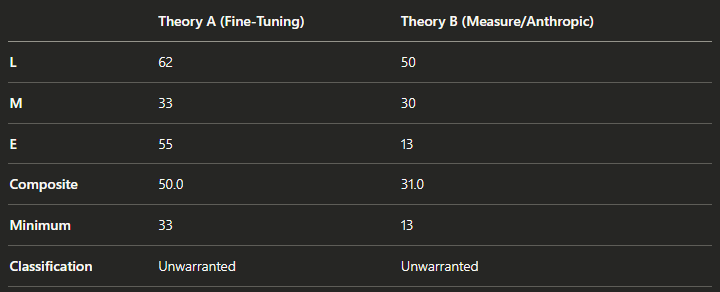
Composite Gap: 19.0 points (Theory A) Discriminating Dimension: E (42-point gap) Cross-Perturbation Robust: Yes Comparative Verdict: Theory A (Fine-Tuning Argument) outperforms Theory B (Measure Problem / Anthropic Selection) on all three dimensions. The ranking is unambiguous and robust under cross-perturbation. The discriminating dimension is Empirical Anchoring, where Theory A draws on well-established physics while Theory B’s positive explanation depends on the empirically unanchored multiverse hypothesis.
The deepest irony of this evaluation is that Theory B’s most effective weapon — the measure-problem critique — wounds both sides equally. Theory B correctly identifies that the fine-tuning argument’s probability claims require a well-defined measure that does not exist. But Theory B’s own positive alternative (anthropic selection in a multiverse) requires the same undefined measure, plus the additional burden of an empirically untested multiverse. The critique is valid; the proposed replacement is weaker than what it seeks to replace.
Neither claim merits warranted assent. Both require developments that do not yet exist: the fine-tuning argument needs a rigorous measure over constant-space and ideally a theistic model generating specific predictions; the anthropic/multiverse alternative needs empirical evidence for any multiverse and a solution to its own measure problem.


